Course Introduction
Foundational certification
Google Cloud Generative AI Leader
Explain generative AI responsibly, map Google Cloud AI products to business outcomes, and guide teams on where GenAI fits. This guide keeps concepts practical and exam-focused.
Want to pass faster?
Get practice tests + the latest deals/discount codes
Free Community Video Course
A comprehensive video series to help you prepare for the Google Cloud Generative AI Leader exam.
Watch NowGenAI concepts
LLMs, embeddings, prompts, grounding, and evaluation - explained for business leaders.
Responsible AI
Safety filters, data governance, and responsible AI guidance that appear on the exam.
Product mappings
When to use Vertex AI Studio, Model Garden, Gemini API, or prebuilt APIs.
Status
Interactive guide is live - more scenarios and flashcards on the way.
Executive Strategy + Responsible AI
Focus on business value, governance, and decision-making with Generative AI rather than implementation details or coding.
Exam Overview
Audience: business leaders, strategists, and decision makers
Length: ~60 minutes
Format: multiple choice
Focus: value creation, responsible AI, and high-impact use cases
Exam Domains (4 Sections)
Open each section for key objectives.
1) Fundamentals of Generative AI
GenAI vs predictive AI: creation vs classification/forecasting.
LLMs and transformers: foundation models like Gemini.
Core terms: tokens, temperature, and hallucinations.
2) Business strategy & value
Use cases: efficiency, growth, and customer experience.
Buy/build/tune: SaaS, prompt engineering, RAG, fine-tuning.
ROI: measure outcomes, not hype.
3) Risks & responsible AI
Risk types: bias, hallucination, IP, and prompt injection.
Governance: HITL, transparency, data privacy, and policy controls.
Shadow AI: mitigate data leakage from consumer tools.
4) Gen AI Apps: Transform Your Work
Delivery model: agile iteration over rigid waterfall plans.
Talent: AI literacy and augmentation, not replacement.
Change management: align teams and adoption metrics.
How to Use This Guide
- Mark off topics as you master them.
- Use self-checks to validate understanding.
- Apply executive scenarios to decisions.
Cheatsheet: Leader Terminology
| Term | Definition |
|---|---|
| Hallucination | Confident but incorrect model output; fix with grounding/RAG. |
| Grounding | Tying AI outputs to trusted enterprise data. |
| Temperature | Creativity knob: low for legal/finance, high for ideation. |
| Multimodal | Models that work with text, images, audio, and video. |
| Zero-shot | Ask without examples; good for quick tasks. |
| Few-shot | Provide 2-3 examples to improve quality. |
Welcome
Use the tabs above to navigate sections and subsections aligned to the Generative AI Leader exam. The content emphasizes definitions, business implications, and Google Cloud offerings.
Flashcards
Fundamentals, offerings, and responsible AI
Question Text
Click to reveal answerAnswer Text
Decision Scenarios
Use these panels to pick the right model, grounding strategy, and platform.
Foundation Model Selection
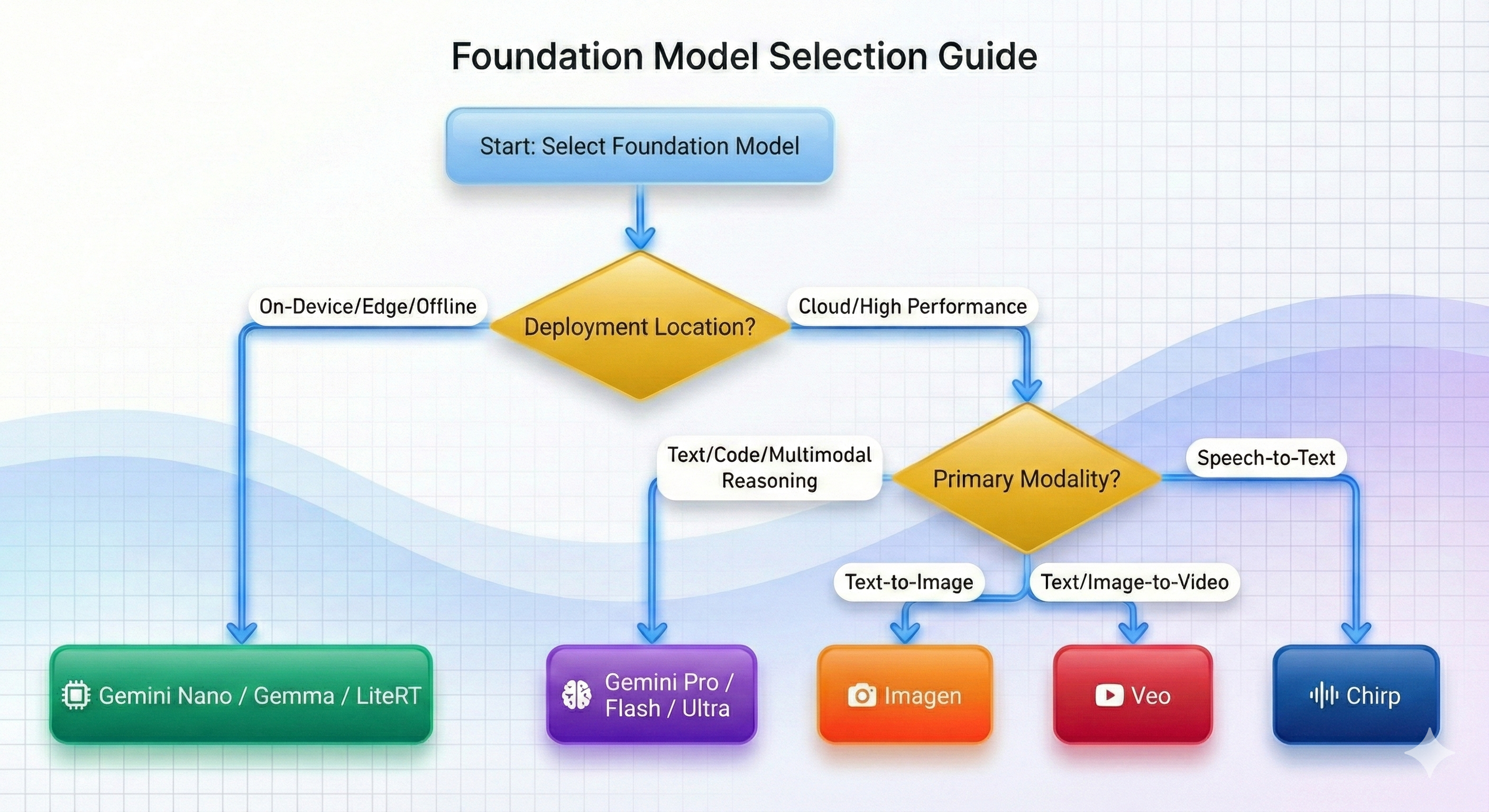
Click the diagram to zoom.
| Need | Best Fit | Notes |
|---|---|---|
| Multimodal reasoning | Gemini | Text+image+code; enterprise controls |
| Lightweight/local | Gemma | Efficient small models |
| Text->Image | Imagen | High-quality images |
| Generative video | Veo | Short clips from prompts |
Tool & Platform Selection
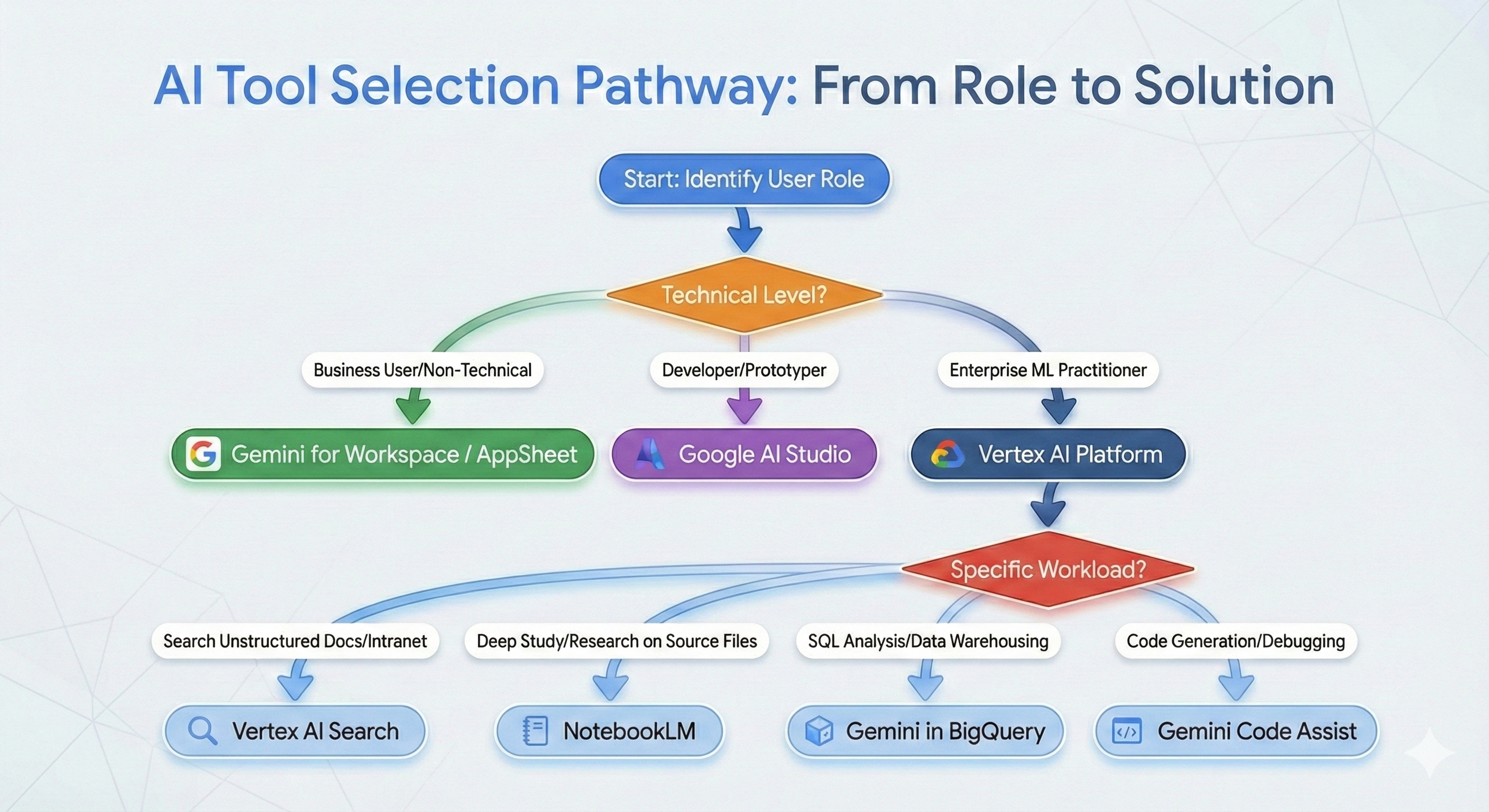
Click the diagram to zoom.
| Need | Tool / Platform | Notes |
|---|---|---|
| Enterprise search & grounding | Vertex AI Search | Index private data and answer with citations |
| Contact center automation | Customer Engagement Suite | Conversational agents, Agent Assist, insights |
| Internal productivity agents | Gemini Enterprise | Search across business systems, action support |
| Custom workflows & tools | Vertex AI + Agent Builder | Build agents with tools, memory, and guardrails |
Agent Design Framework
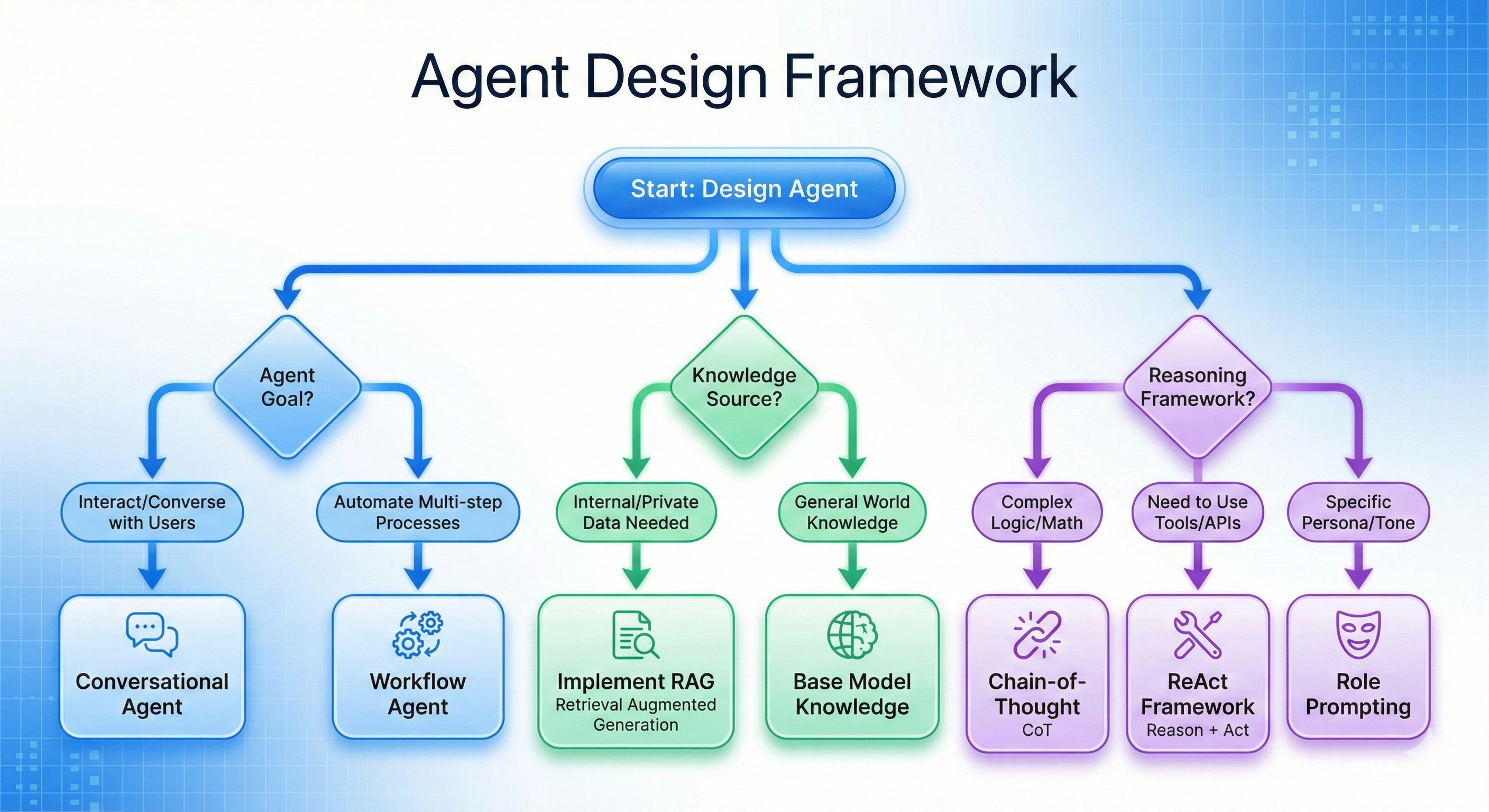
Click the diagram to zoom.
Build With AI Options
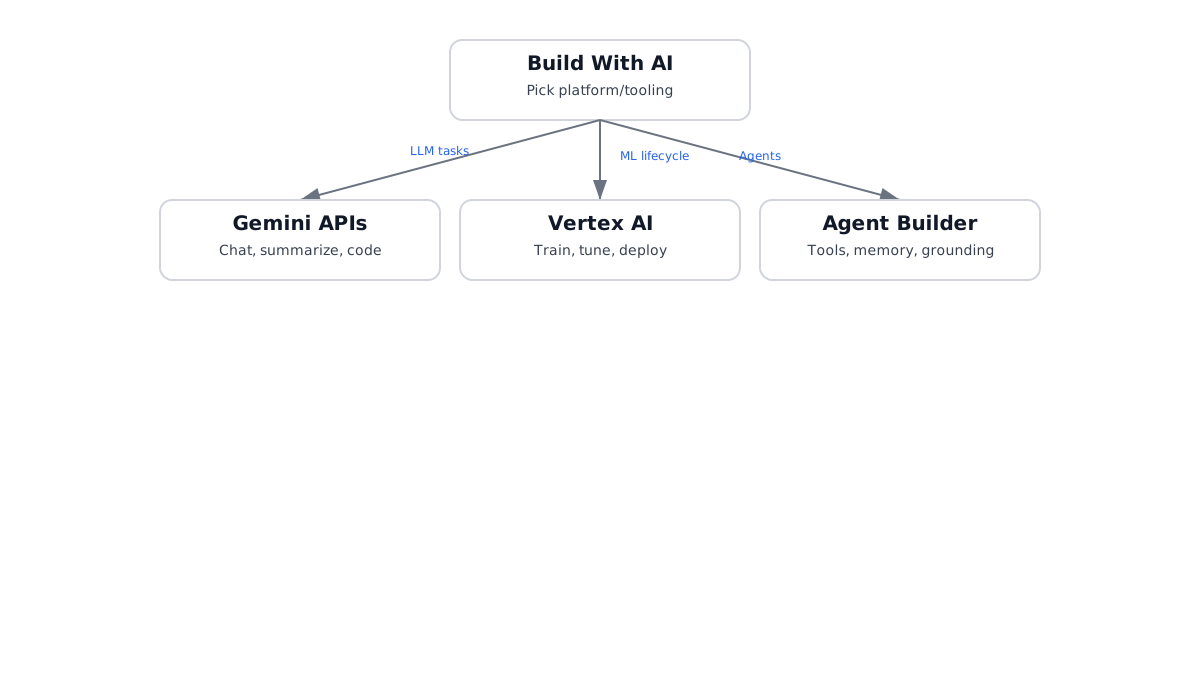
Click the diagram to zoom.
| Option | Best For | Notes |
|---|---|---|
| Gemini APIs | Chat/summarize/code | Fast start; enterprise controls |
| Vertex AI | Train/tune/deploy | Pipelines, Model Garden, eval |
| Agent Builder | Task-oriented agents | Tool use, memory, grounding |